
Download the full release here (PDF)
MEDIA RELEASE
FRIDAY MARCH 27, 2026
NEW home building data is flatlining, according to the latest Master Builders Tasmania data and builders need more certainty and less red tape to help Tasmanians get a roof over their head.
MBT’s industry forecasts released today show that prospects for new home building have diminished since previous release six months ago.
The forecast shows just 11,850 new homes will get started in Tasmania over the Housing Accord’s five-year term, which is less than half the state’s target.
MBT’s CEO Jenna Cairney said it was concerning these forecasts didn’t take into consideration the most recent interest rate hike as well as the cost escalations due to the conflict in the Middle East.
“Tasmania looks set to miss its housing target by 14,000 homes,” Ms Cairney said.
“Not only are we failing to deliver on this target, but home building in Tasmanian will be 26 per cent lower than in the five-year period just before the Accord.”
The February CPI figures released this week shows inflation is still out of control with new house build costs growing at their fastest rate in 16 months.
Ms Cairney said it was concerning that essential legislation to pause new red tape failed to be debated in parliament yesterday due to a lack of bipartisan support.
“Builders have been imploring the Tasmanian Government to pause the new National Construction Code as soon as possible,” she said.
“We and our industry colleagues call for bipartisan support for this legislation that will give the industry some much needed certainty.
“Parliament can’t control what happens in the Middle East, and it can’t control national inflation, but it can stop new red tape and give builders and would-be home owners some much needed breathing space from the chokehold of regulation.”
Building’s economic bright spots
A SURGE in commercial building over the next three years will be the shining light of Tasmania’s economy, according to new forecasts by Master Builders Tasmania.
Tasmania’s non-residential building sector endured a rough time in 2024-25, with an unanticipated early state election, activity slipped by 4.6 per cent during the year, dragging the size of the market down to $926.4 million.
However, the pipeline is set to recover with 30.2% growth forecast in 2025-26 and 35.2% growth in 2026-26.
“Non residential activity is expected to go from more than $1.2 billion this financial year to $1.8 billion in 2027-28,” Master Builders Tasmania CEO Jenna Cairney said.
The civil and engineering construction pipeline is also set to soar reaching a $3.9 billion of activity in 2028-29 – almost $14 billion from 2026 to 2030
“For every dollar spent in construction there is on average a $3 return to the economy. And that multiplier effect increases in the non-residential space – that is the schools, the hospitals, the sporting facilities as well as the private investment in shopping centres, hotels and GP clinics or aged facilities.”
Given the scale of growth in the state’s most crucial sector, Ms Cairney said it was appropriate the Tasmanian Government had created an agency designed to keep infrastructure delivery on track.
“Building Tasmania has the potential to help government deliver its pipeline of work in an efficient way, maximising the return on investment to Tasmanian businesses,” Ms Cairney said.
With inflation showing no sign of slowing down, another increase in interest rates and the situation in the Middle East likely to lead to cost escalations, the government needs to stay the course and act as a model client to ensure the sector can thrive.
Last week, Master Builders Tasmania hosted the Tasmania First Taskforce meeting with its coalition of peaks and Minister Kerry Vincent.
“The message to the Minister was clear.
“Building Tasmania and the government need to work alongside industry to ensure the new Macquarie Point Stadium is delivered in parallel with the pipeline of public sector investment.
“Government’s new agency is timely, but we would strongly encourage the Government to ensure the Minister’s portfolio includes workforce and training to ensure we have the employees we need for the opportunity that lies ahead.”
Industry comments
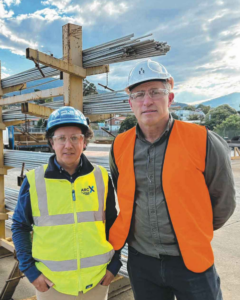 Photo caption: Tasmania Area Manager for The Australian Reinforcement Company James Harris with Hansen Yuncken Construction Manager for Tasmania Julian Proud
Customer inquiry on the rise
AFTER the completion of Southern Tasmania’s Bridgewater Bridge, The Australian Reinforcement Company (ARC) witnessed a general slowdown in the Tasmanian market.
However, Tasmania Area Manager James Harris said the next 12-24 months were looking up in the commercial building space.
ARC has manufacturing facilities in Montrose, as well as in the state’s north and north west, and employs about 35 people.
“We are seeing customer quoting and inquiry increasing in the commercial sector and are hopeful that will lead to a solid stream of work over the next two years,” Mr Harris said.
ARC has had a presence in Tasmania since the 1960s and is a subsidiary of Infrabuild, which is a fully integrated Australian steel manufacturing and recycling business.
“With ongoing global economic uncertainty, our integrated local supply chain puts us in a strong position to maintain reliable product availability to support continued construction activity,” Mr Harris said.
ARC supplies for civil, residential and commercial projects.
Mr Harris said demand in the residential market was still flat but that ARC stood ready to provide affordable and efficient steel products to keep the sector moving.
“We continue to innovate.
“We have new products with LOKPOD®, a 100% recycled plastic void former for residential slabs, and SENSE 600® a reinforcing steel made from 100% scrap that delivers a higher strength solution with and a reduced overall mass, meaning less material can often be used without compromising strength.”
Julian Proud – Hansen Yuncken
“With the Tasmanian commercial construction industry, currently looking uniquely positive, with significant projects that are currently in construction in the North, the Northwest as well as the South, along with a strong pipeline forecast to be constructed in the foreseeable future in each of the three regions,” said Julian Proud, State Construction Manager for Hansen Yuncken.
“There is a great opportunity for the industry to invest in the upskilling of our people and the broader capacity of our sector.
“Going forward, it will be critical that this ongoing and clear communication from both the government and private sector stakeholders to keep the construction industry well informed as it prepares for an uplift in labour and materials resource demand and the pressures that come with it, particularly for scopes that may run, not only in parallel to the stadium but to prepare us for beyond when the stadium is completed.”